


Page 10 - RD_2024-12
P. 10
MAKING LIMELIGHT      Kev Franzi


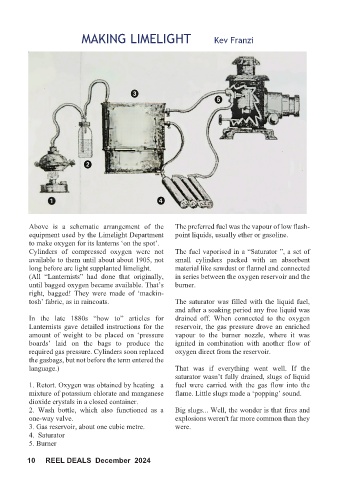
        Above  is  a  schematic  arrangement  of  the  The preferred fuel was the vapour of low flash-
        equipment used by the Limelight Department  point liquids, usually ether or gasoline.
        to make oxygen for its lanterns ‘on the spot’.
        Cylinders  of  compressed  oxygen  were  not  The fuel vaporised in a “Saturator ”, a set of
        available to them until about about 1905, not  small  cylinders  packed  with  an  absorbent
        long before arc light supplanted limelight.  material like sawdust or flannel and connected
        (All  “Lanternists”  had  done  that  originally,  in series between the oxygen reservoir and the
        until bagged oxygen became available. That’s  burner.
        right,  bagged!  They  were  made  of  ‘mackin-
        tosh’ fabric, as in raincoats.      The saturator was filled with the liquid fuel,
                                            and after a soaking period any free liquid was
        In  the  late  1880s  “how  to”  articles  for  drained  off.  When  connected  to  the  oxygen
        Lanternists  gave  detailed  instructions  for  the  reservoir, the gas pressure drove an enriched
        amount  of  weight  to  be  placed  on  ‘pressure  vapour  to  the  burner  nozzle,  where  it  was
        boards’  laid  on  the  bags  to  produce  the  ignited  in  combination  with  another  flow  of
        required gas pressure. Cylinders soon replaced  oxygen direct from the reservoir.
        the gasbags, but not before the term entered the
        language.)                          That  was  if  everything  went  well.  If  the
                                            saturator wasn’t fully drained, slugs of liquid
        1. Retort. Oxygen was obtained by heating   a  fuel  were  carried  with  the  gas  flow  into  the
        mixture of potassium chlorate and manganese  flame. Little slugs made a ‘popping’ sound.
        dioxide crystals in a closed container.
        2.  Wash  bottle,  which  also  functioned  as  a  Big slugs... Well, the wonder is that fires and
        one-way valve.                      explosions weren't far more common than they
        3. Gas reservoir, about one cubic metre.  were.
        4.  Saturator
        5. Burner

        10     REEL DEALS  December  2024

