


Page 13 - RD_2025-06
P. 13
Color

        The color rendering of Kodachrome films was unique in color photography for several
        decades  after  its  introduction  in  the  1930s.  Even  after  the  introduction  of  other
        successful professional color films, such as Fuji Velvia, some professionals continued
        to prefer Kodachrome, and maintain that it still has certain advantages over digital.

        Contrast
        Kodachrome  was  a  reversal  film  -  the  film  used  in  the  camera  was  processed  and
        returned  as  a  positive  print,  intended  for  direct  projection.  As  such,  it  possesses  a
        relatively high contrast.

        For professional uses, where duplication is expected and required, a special version,
        Kodachrome  Commercial  (KCO),  was  available  in  35  mm  (exclusively  through
        Technicolor) and in a 16 mm base (exclusively through Eastman Kodak's professional
        products division). In both cases, Eastman Kodak performed the processing.

        Kodachrome  Commercial  has  a  low-contrast  characteristic  that  complements  the
        various  duplication  films  with  which  it  is  intended  to  be  used:  silver  separation
        negatives for 35 mm (controlled exclusively by Technicolor) and reversal duplicating
        and printing stocks for 16 mm (controlled exclusively by Eastman Kodak).

        From a film collectors’ perspective, Kodachrome offered mixed blessings. During the
        1950s, some 16mm color features were released on Kodachrome. Whilst they have
        retained their color well, they are often seen to have too much contrast. This results in
        darkish areas appearing mostly black with little of no detail.

                                          Mike Trickett, with the help of Wikipedia.
        Credits:  All images from the author’s collection.

        Thanks to Rodney Bourke for the idea.
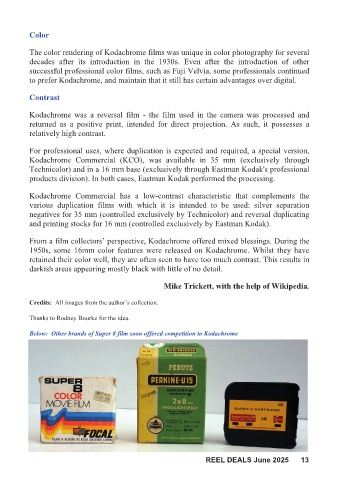
        Below:  Other brands of Super 8 film soon offered competition to Kodachrome


                                                     REEL DEALS June 2025      13

