


Page 12 - RD_2025-06
P. 12
In 1961, Kodak released Kodachrome II with a faster speed of 25 ASA and claiming to
        produce sharper images. In 1962, Kodachrome-X at 64 ASA was introduced. In 1974,
        with  the  transition  to  the  K-14  process,  Kodachrome  II  and  Kodachrome-X  were
        replaced by Kodachrome 25 and Kodachrome 64.

        Decline and discontinuation

        Later color transparency films, such as Agfachrome, Anscochrome, Fujichrome and
        Kodak's own Ektachrome used simpler, quicker, and more accessible color development
        processes.  Their  higher  film  speeds  also  eroded  Kodachrome's  market  share,  as  the
        quality of competing films improved over time. When digital photography reduced the
        demand for all film after 2000, Kodachrome sales further declined. On June 22, 2009,
        Kodak announced it would no longer manufacture Kodachrome film, citing declining
        demand.

        2017 reintroduction rumours

        After announcing the return of Ektachrome at the beginning of 2017, Eastman Kodak
        CMO Steven Overman told The Kodakery podcast, "we are investigating Kodachrome,
        looking at what it would take to bring that back". Although the statement generated
        widespread media interest, it was subsequently conceded by an official at Kodak Alaris
        (which would be responsible for its production and sale) that the return of Kodachrome
        was  probably  impractical  (due  to  the  difficulty  in  restoring  the  now-dismantled
        infrastructure needed to support it) and therefore unlikely.

        Emulsion

        Kodachrome  films  are  non-substantive.  Unlike
        substantive  transparency  and  negative  color  films,
        Kodachrome film does not incorporate dye couplers
        into the emulsion layers. The dye couplers are added
        during  processing.  This  means  that  Kodachrome
        emulsion layers are thinner and less light is scattered
        upon exposure, meaning that the film could record an
        image  with  more  sharpness  than  substantive  films.
        Transparencies made with non-substantive films have
        an easily visible relief image on the emulsion side of
        the  film.  Kodachrome  64  and  200  can  record  a
        dynamic range of about 2.3D or 8 f-stops, as shown in
        the   characteristic   curves.   Kodachrome   25
        transparencies  have  a  dynamic  range  of  around  12
        f-stops, or 3.6–3.8D


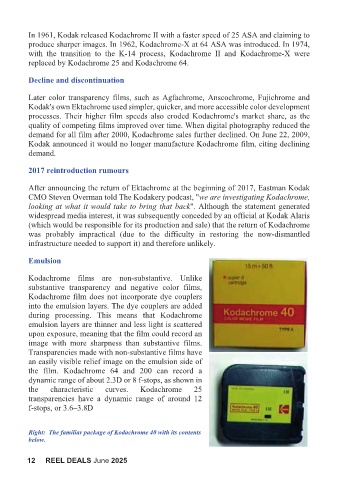
        Right:  The familiar package of Kodachrome 40 with its contents
        below.

        12     REEL DEALS June 2025

