


Page 11 - RD_2025-06
P. 11
As a young owner of an 8mm movie camera circa 1958, saving pocket money to raise
        the  the  £2/2/6  for  a  50  ft  roll  of  8mm  Kodachrome  took  a  few  weeks  of  saving.  I
        remember being devastated when Kodak raised to price to £2/12/6*. Of course there
        were  no  discounts  in  those  days  -  everyone  sold  at  the  same  fixed  price!
        * The RBA calculator tells me that is equivalent to about $100.00 in today’s values.
        Eventually, the growth and popularity of alternative photographic materials, and, much
        later, the widespread transition to digital photography, led to Kodachrome’s loss of
        market  share.  Its  manufacture  was  discontinued  in  2009,  and  processing  ended  in
        December 2010. In early 2017, Kodak announced it was investigating the possibility of
        re-introducing Kodachrome, but later conceded that this was unlikely to happen.

        Kodachrome is appreciated by the archival and professional market for its accurate
        color reproduction and storage longevity.  It is common to find Kodachrome 16mm and
        8mm  home  movies  with  color  as  vibrant  as  the  day  they  were  filmed  -  unlike  the
        competitors’ products, which have frequently faded to pink or otherwise lost color.

        History

        Before  Kodachrome  film  was  marketed  in  1935  most  color  photography  had  been
        achieved  using  films  that  employed  additive  color  methods  and  materials,  such  as
        Dufaycolor. These first color processes had several disadvantages,  because they used
        a réseau filter made from discrete color elements that was embossed onto the surface of
        the film. The image was captured on a black and white emulsion after the filter.

        Unfortunately, the color pattern introduced two distinct problems. It was visible on the
        screen upon projection, and it absorbed between 70% and 80% of light output of the
        projector, thereby requiring very bright projection lamps, especially for large screens.
        Subtractive color systems such as Kodachrome avoided these disadvantages.
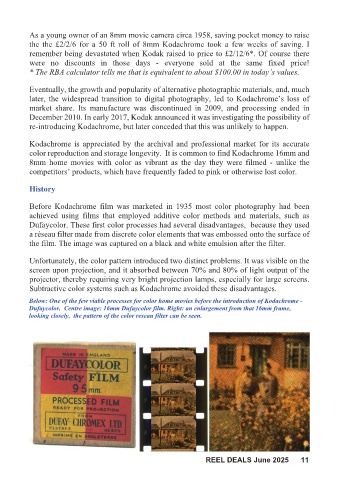
        Below: One of the few viable processes for color home movies before the introduction of Kodachrome -
        Dufaycolor.  Centre image: 16mm Dufaycolor film. Right: an enlargement from that 16mm frame,
        looking closely,  the pattern of the color reseau filter can be seen.


                                                     REEL DEALS June 2025      11

