


Page 17 - RD_2025-09
P. 17
38 mm (1½”) focal length. This provides
        a nice sized image for home use from
        both 9.5 and 16 mm film.  (I have often
        wondered why the ‘standard’ lens sup-
        plied with 16 mm projectors for in-home
        use was 50 mm (2”). This results in a
        pretty small image at the usual distance
        to the screen in a home setting).
        A nice feature is a threading light incor-
        porated  into  the  top  front  of  the  lamp
        house; it is on when the projection lamp
        is off and vice versa.
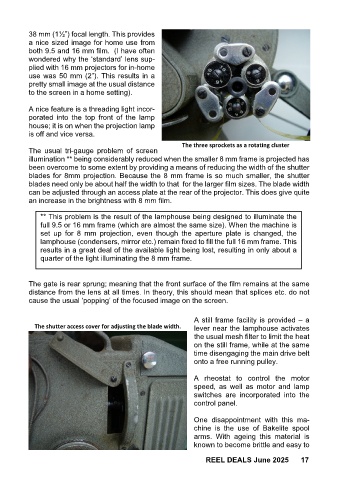
                                              The three sprockets as a rotating cluster
        The  usual  tri-gauge  problem  of  screen
        illumination ** being considerably reduced when the smaller 8 mm frame is projected has
        been overcome to some extent by providing a means of reducing the width of the shutter
        blades for 8mm projection. Because the 8 mm frame is so much smaller, the shutter
        blades need only be about half the width to that  for the larger film sizes. The blade width
        can be adjusted through an access plate at the rear of the projector. This does give quite
        an increase in the brightness with 8 mm film.
           ** This problem is the result of the lamphouse being designed to illuminate the
           full 9.5 or 16 mm frame (which are almost the same size). When the machine is
           set  up  for  8  mm  projection,  even  though  the  aperture  plate  is  changed,  the
           lamphouse (condensers, mirror etc.) remain fixed to fill the full 16 mm frame. This
           results in a great deal of the available light being lost, resulting in only about a
           quarter of the light illuminating the 8 mm frame.


        The gate is rear sprung; meaning that the front surface of the film remains at the same
        distance from the lens at all times. In theory, this should mean that splices etc. do not
        cause the usual ‘popping’ of the focused image on the screen.

                                                 A still frame facility is provided – a
          The shutter access cover for adjusting the blade width.  lever near the lamphouse activates
                                                 the usual mesh filter to limit the heat
                                                 on the still frame, while at the same
                                                 time disengaging the main drive belt
                                                 onto a free running pulley.
                                                 A  rheostat  to  control  the  motor
                                                 speed,  as  well  as  motor  and  lamp
                                                 switches  are  incorporated  into  the
                                                 control panel.

                                                 One  disappointment  with  this  ma-
                                                 chine  is  the  use  of  Bakelite  spool
                                                 arms.  With  ageing  this  material  is
                                                 known to become brittle and easy to

                                                     REEL DEALS June 2025      17

