


Page 9 - RD_2025-09
P. 9
As far as can be ascertained, the film had to be loaded
        into the cassette by the owner, it being quite different
        compared  to  the  more  common  Pathé    9.5  mm  film
        charger.  The  lens  was  a  Taylor-Hobson  with
        variable aperture.

        In  camera  mode  it  operated  fixed  focus.  A  fold
        down  viewfinder  was  mounted  on  the  top  of  the
        body. In projection mode, an internally mounted torch
        bulb  was  powered  by  the  battery  pack  and
        film transportation was via a foldable handle protruding
        from the side of the unit.

        I have a few home movie films in my collection which
        were taken with one of these cameras and the results are
        surprisingly good - one shot on Kodachrome is of the
        royal visit decorations in Melbourne in 1954.

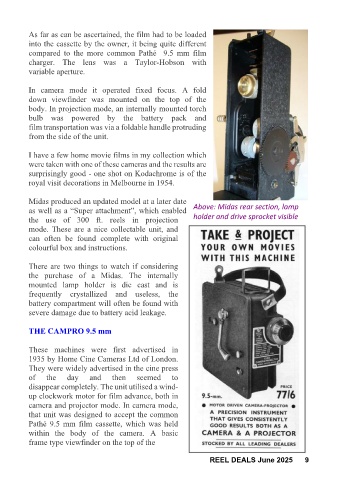
        Midas produced an updated model at a later date
        as well as a “Super attachment”, which enabled  Above: Midas rear section, lamp
        the  use  of  300  ft.  reels  in  projection  holder and drive sprocket visible
        mode. These are a nice collectable unit, and
        can  often  be  found  complete  with  original
        colourful box and instructions.

        There are two things to watch if considering
        the  purchase  of  a  Midas.  The  internally
        mounted  lamp  holder  is  die  cast  and  is
        frequently  crystallized  and  useless,  the
        battery compartment will often be found with
        severe damage due to battery acid leakage.

        THE CAMPRO 9.5 mm

        These  machines  were  first  advertised  in
        1935 by Home Cine Cameras Ltd of London.
        They were widely advertised in the cine press
        of   the   day   and   then   seemed   to
        disappear completely. The unit utilised a wind-
        up clockwork motor for film advance, both in
        camera and projector mode. In camera mode,
        that unit was designed to accept the common
        Pathé 9.5 mm film cassette, which was held
        within  the  body  of  the  camera.  A  basic
        frame type viewfinder on the top of the

                                                      REEL DEALS June 2025      9

